In material conveying systems for mining, building materials, chemical processing, and bulk handling industries, belt conveyors are essential equipment. Among them, large-incline belt conveyors and flat belt conveyors are the two most commonly used types and are often compared during equipment selection.
The key difference between large-incline belt conveyors and flat belt conveyors lies in the conveying angle.
Flat belt conveyors are mainly designed for horizontal or small-angle conveying, typically not exceeding 28°, while large-incline belt conveyors are capable of high-angle and even vertical conveying (up to 90°). This fundamental difference determines their material adaptability, installation requirements, and application scenarios.
This article compares large-incline belt conveyors and flat belt conveyors from five core dimensions to help users accurately select the most suitable solution for their production needs.

Flat belt conveyors are limited in conveying angle, generally within 28°. When this angle is exceeded, materials tend to slide backward or scatter, which reduces conveying efficiency and increases material loss.
They are best suited for:
Horizontal or small-incline conveying
Short-distance material transfer
Finished products or bulk materials with good flowability
Typical applications include workshop material transfer and port bulk handling.
Large-incline belt conveyors are designed for wide-angle adaptability, allowing smooth transition from horizontal conveying to steep inclines and even vertical lifting.
They are especially suitable for:
Bulk materials such as coal, ore, sand, gravel, and grain
Sites with limited space but large lifting height requirements
Underground mines, mountainous areas, and multi-floor factory layouts
In large-angle conveying scenarios, large-incline belt conveyors clearly outperform flat belt conveyors.
Although structurally simple, flat belt conveyors often require:
Longer conveyor length to maintain small inclination
More complex tensioning systems
Larger horizontal installation space
During installation planning, sufficient floor space must be reserved. In addition, maintenance and disassembly of certain components can be relatively inconvenient.
Large-incline belt conveyors adopt a compact structural design, featuring conveyor belts with corrugated sidewalls and cross diaphragms, which are critical for large-angle conveying.
This design offers:
Reduced dependence on auxiliary devices
Easier installation, disassembly, and maintenance
Significant savings in floor space
For production sites with limited installation space, large-incline belt conveyors can effectively improve space utilization and reduce infrastructure costs.
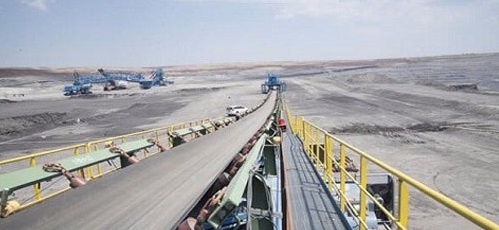
Under horizontal or small-angle conditions, flat belt conveyors provide acceptable conveying stability. However, when operating near the maximum angle limit, materials may slide and cause uneven loading.
This sliding increases friction between materials and the belt, which can accelerate belt wear and shorten service life.
Large-incline belt conveyors are designed to ensure smooth material transition from horizontal to inclined sections, minimizing impact and sliding.
Their belts are manufactured from high-strength materials and protected by sidewalls and cross diaphragms, which:
Bear the gravity load during steep conveying
Reduce direct material-to-belt friction
Extend belt service life
As a result, large-incline belt conveyors generally offer greater durability and lower long-term maintenance costs.
Material scattering is a common issue in belt conveying, especially for bulk materials.
Due to the lack of protective structures, flat belt conveyors are more prone to material scattering during inclined conveying. Even during horizontal operation, material leakage may occur under fluctuating loads or speed variations.
Large-incline belt conveyors are specifically designed to address this problem. Their corrugated sidewalls prevent material from spilling sideways, while cross diaphragms support the material and prevent back-sliding.
This forms a relatively enclosed conveying space, resulting in:
Significantly reduced material loss
Lower cleaning and maintenance requirements
Higher overall conveying efficiency
These advantages make large-incline belt conveyors ideal for applications with strict environmental and efficiency requirements.
The head and tail sections of flat belt conveyors have limited flexibility. When connecting with crushers, screens, or feeders, additional transition equipment is often required, making system integration less flexible.
Large-incline belt conveyors offer greater flexibility at both the head and tail sections. They can be easily integrated with:
Crushers
Vibrating screens
Feeders
Flat belt conveyors
This flexibility allows efficient multi-equipment linkage, optimized production line layouts, and reduced transfer losses, making them suitable for large-scale and automated production systems.
Large-incline belt conveyors and flat belt conveyors are not “better or worse,” but different in application suitability.
Choose a flat belt conveyor if your application involves horizontal or small-incline conveying (≤28°), sufficient installation space, and relatively simple system integration requirements.
Choose a large-incline belt conveyor if your project requires steep or vertical conveying (>28°), bulk material handling, limited site space, or flexible integration with multiple pieces of equipment.
When making a final decision, it is recommended to consider material characteristics, conveying angle, site conditions, and production efficiency requirements. Consulting experienced belt conveyor manufacturers can help ensure the selected equipment achieves optimal performance while reducing operating costs.